The research
Why external shading?
British homes weren’t built for the summers we’re getting. Cool them with air-con and you burn energy fighting a problem you could have stopped at the window. The evidence — from architects, a peer-reviewed review, the national press and the UK’s own climate risk assessment — keeps landing on the same answer: block the sun before it reaches the glass.

Solar gain
Blocks up to 95%
A blackout blind fully lowered outside the glass rejects up to 95% of solar heat, per the industry body’s own EN 14501 figures. It stops the sun before it enters — where internal blinds and film only catch it once it’s already in.
Measured result
3.5°C cooler at peak
Measured on an external roller blind by the University of Brighton, alongside a 1.8°C drop in mean summer temperature.
Works with your AC
Saving you money
A University of Brighton trial found external roller blinds cut a room’s cooling load by up to 20% — so your air-con works less, and costs less to run.
The consensus
Block it before it hits the glass.
- A 2026 peer-reviewed review names stopping heat before the glass as the single best strategy — not managing it once it’s in.1
- Architects agree. “The biggest bang for your buck is to add exterior shading to a building,” says Ruth Mandl, co-founder of New York firm CO Adaptive, in the FT.
- The Climate Change Committee calls heatwaves the UK’s single greatest climate health risk.
- 92% of UK homes are expected to be prone to overheating by 2050 on current trends.2
- Engineers agree, too. “Even a rudimentary covering on the outside of a window can stop 100% of solar gain,” says chartered engineer Tom Greenhill of Heatwave Toolkit — closing internal blinds alone cuts only about 10%.
- Nature Reviews Clean Technology, 2026
- UK Climate Change Committee (CCC)
“Embracing the crack den chic, just trying to keep ourselves and our dog cool.”
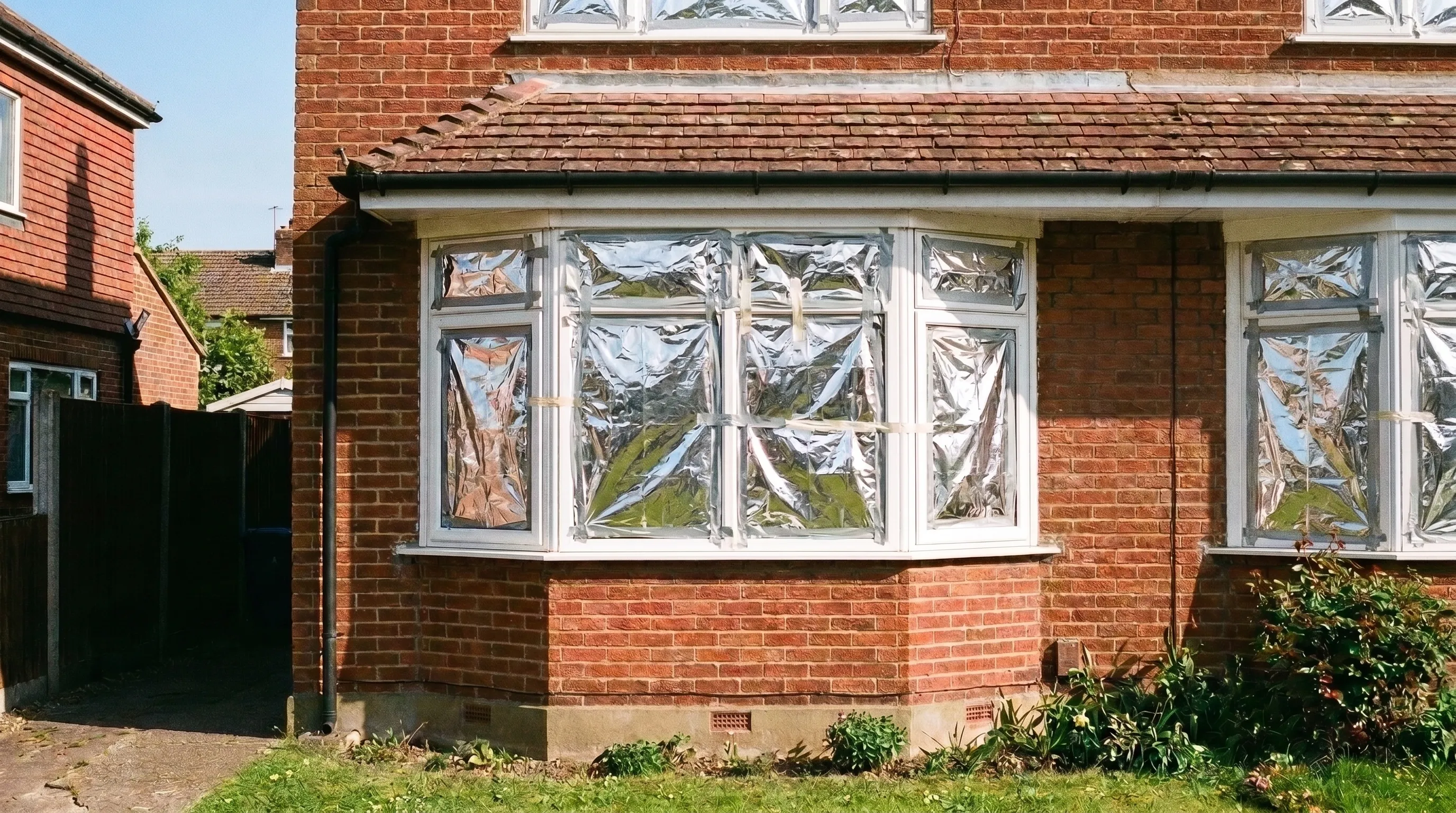
No mirror glare, no tape sagging off in a heatwave, no risk to the glass itself. Just a muted, heritage-matched blind that looks like it belongs on the house, because it does.
Frequently asked questions.
Why don’t internal blinds or curtains work against heat?
Because an internal blind or curtain sits behind the glass, where the heat already is. It changes how a room looks, but the sun is in by then — you’re managing heat rather than stopping it. Worse, the fabric absorbs that heat and re-radiates it into the room, which is why the same fabric measures three to five times better mounted outside the window than inside it.
Does stick-on reflective window film work?
Stick-on reflective window film doesn’t work for long. It tends to go floppy and drop off once it warms up, it can overheat and crack a sealed double-glazed unit, and it leaves you with the mirror-foil look. It also sits on the wrong side of the glass: film is applied indoors, so like an internal blind it only acts once the sun is already through the window.
Why a roller blind and not an awning?
Because a roller blind covers the whole pane, where an awning only shades from above — so low west and east sun, the hardest to stop, ducks straight under it1. An external roller catches that low sun and can black a room out. It also comes down, so you raise it for winter instead of losing the low sun a fixed overhang would block. The honest trade-off: you lose some of the view when it’s down, so you raise it when you don’t need it.
- Architect James Hurst, writing in The Times
Will an external blind actually cool my room?
An external blind stops up to 95% of the sun’s heat at the window, so yes — it cuts what reaches the room. How much cooler the room then feels is a separate question, and a more honest one to split in two.
- Heat stopped at the window: up to 95%. A blackout blind lowered outside the glass rejects up to 95% of the sun’s heat1. Closing an internal blind stops around 10%. The whole difference is which side of the glass the fabric sits on.
- How much cooler the room feels: it depends. On the window, its aspect, your glazing, and how long the sun sits on it. The nearest measured answer is a University of Brighton trial of an external roller blind — 3.5°C off the peak, 1.8°C off the mean, across a summer2.
- Is a few degrees worth the bother? Mid-heatwave, the gap between a room you can use and one you can’t is genuinely that narrow. It also works while you’re out, costs nothing to run, and stacks on top of whatever else you’re already doing — it isn’t a choice between this and a fan or air-con.
That trial was someone else’s blind on someone else’s window. We won’t put a temperature figure on our own kit until our own testing is done.
- BBSA Fabrics Module, g_tot per EN 14501 — an industry-body figure, for the blind fully closed
- Ip, Ylitalo & Marshall, Univ. of Brighton
Does an external blind save money on air conditioning?
Yes — an external roller blind cuts a room’s cooling load by up to 20%, so air-con you already run has around a fifth less work to do. The blind doesn’t replace air conditioning; it lowers the bill for running it. The arithmetic:
- UK air-con running costs average roughly £1–£2.70 a day per room in a heatwave — about £150–£250 for a season1.
- An external roller blind cuts a room’s cooling load by up to 20%2, so the same air-con unit has around a fifth less work to do.
- The blind is £150 per window, one-off, and next to nothing to run — so the saving stacks on top of whatever you already spend on air-con, rather than asking you to choose one or the other.
- For context: buying and running a portable unit for a full season typically adds up to £450–£1,000+ once purchase price is included3.
- Uswitch/Opinium UK household survey, 2026
- University of Brighton trial (Ip, Ylitalo & Marshall)
- Desk research — External Shading Technical Evidence
Do I need planning permission for an external blind?
Usually not. A removable fabric blind on the outside of a window generally doesn’t need planning permission, and is easier to have accepted than fixed external shutters, precisely because it can be taken down. The reason is that planning control bites on alteration — and a fabric blind that lifts off its brackets and leaves two plugged holes generally isn’t one. Conservation areas, listed buildings and front elevations can be stricter, so check with your local planning authority — happy to help you word the question.
What’s the best way to block the sun from a window?
Shade it from the outside. That’s the consensus across the peer-reviewed literature, the engineers quoted above, and the government’s own overheating rules for new homes — which count external shutters and blinds as a solution, and refuse to count internal blinds or curtains at all1. The reason is the same every time: anything mounted outdoors stops the sun before it reaches the glass, while anything indoors can only deal with the heat once it’s already in the room.
- Do External blind or shutter. Stops up to 95% of the sun’s heat, and rolls up or comes off out of season.
- Limited External awning, overhang or planting. Outside the glass, so the principle is right — but it shades from above, and low morning and afternoon sun passes underneath it.
- Don’t Internal blinds and curtains. Around 10%, and the fabric warms up and re-radiates the heat into the room.
- Don’t Stick-on reflective film. The least durable of the options, and it goes on the indoor face of the glass — the wrong side.
- Approved Document O, Building Regulations — it applies to new-build homes rather than retrofits like ours, but it reflects the settled official view of what works
How do I stop a south-facing room overheating in summer?
Shade the glass from outside on the windows that take the longest direct sun, then ventilate at night to dump the heat that still gets in. Worth knowing: on a south-facing room the worst window is often the west-facing one, because low afternoon sun arrives almost horizontally and slides under anything that shades from above — an overhang, a balcony, an awning. That low, flat sun is the case for something covering the full pane rather than shading from the top.
Will it stand up to British wind and rain?
So far, yes. The fabric is solution-dyed acrylic awning cloth — water-repellent and rot-proof, the same material used on garden awnings — and the blind is held taut top and bottom rather than hanging loose, so it doesn’t flap or snap about in a breeze. The prototype has been on our own first-floor sashes through this summer, including the windy spell in mid-July, with nothing worked loose and no damage.
- Ordinary British weather: leave it down. Rain runs off it, and it’s tensioned rather than free-hanging, which is what stops the flapping that wrecks a loose blind.
- A named storm: roll it up. It rolls away in seconds and comes off its brackets in a few minutes. The honest advice is to retract it in a real storm, exactly as you would a garden awning or a parasol — we’d rather say that than pretend it’s a shutter.
That’s one prototype on one London terrace, not an independent wind-load test. We won’t publish a wind rating until the kit has been tested properly.
Will it fit my windows if they aren’t sash windows?
The kit is designed around the recessed reveals of Victorian and Georgian sash windows — that reveal is what the cassette sits in, so it’s what everything is optimised for. Other window types aren’t ruled out; they’re untested, and we’d rather tell you that than sell you a maybe. If yours are flush-fitted, casements, or something else entirely, join the list anyway and say what you’ve got — knowing which windows people actually want this on is genuinely useful, and it shapes what gets built after the first batch.